The Republic of Grozovia, more commonly known as Grozovia, is a post-Soviet republic in the Green Sea region, north of the Caucasus Mountains. Grozovia is bordered by the Russian Federation to the south and west, Ardistan to the north and the Green Sea to the east. The capital, Zagorsk, is situated centrally on the eastern coastline and acts as the center of government and military administration for the nation. Other major settlements can be found along the nation’s coast, most notably the city of Beketov.
Grozovia has been inhabited from at least the 6th Century, with Slavic peoples settling the area sometime around the 10th Century. Various dukedoms controlled the region until the nation was united in the 14th Century by Gojmir Homolka. Grozovia joined the Russian Empire in 1733, and only regained its independence upon the dissolution of the USSR in 1991.
Since its independence, Grozovia has maintained strong ties with its brother and ally to the north-east, Chernarus. In 2009, a civil war would erupt in the predominantly ethnically Russian province of South Zagoria, instigated by the Chernarussian Movement of the Red Star who sought to unify with Russia. When the conflict first erupted, Grozovia sent 1,500 troops in support of the Chernarussian Defence Forces. The two nations have been strategically and economically inseparable ever since.
Early History
The earliest known inhabitants of what is now Grozovia were the Kumyks, a turkic tribe who inhabited the north-western valleys of the river Sulla-Chubutla, near modern day Pecher, sometime in the 6th Century. Around the 7th century the Kumyk tribes divided, with some migrating north to establish the foundations of what is now Ardistan.
Slavic peoples inhabited the area sometime around the 10th and 11th Centuries. The basis of modern Grozovia was established in the eastern valleys along the banks of the Chorkvkika river, near modern day Lybor. Cultural and ideological differences led to a bitter rivalry between the Slavs of the east and the Kumyks of the west. Though the Solveka mountain ranges provided a natural barrier against turkic raiders, this did not deter the Kumyks from pillaging villages along the Chorkvkika and killing and/or enslaving hundreds Slavic settlers.
The first of several dukedoms were established in the area during the 11th and 12th Centuries, the most notable of which being the Stasov duchy in East Zagorscak (modern day Zagorsk), headed by Duke Zdenko Stasov. Stasov constructed a series of castles and keeps to protect his dukedom from raids via the Green Sea and Solveka Mountains. Stasov’s dynasty would collapse at the turn of the 13th century, precipitating the collapse of his fortress system; two notable ruins remain of his work – the infamous Razstava Castle and the lesser-known Zog keep. Despite the collapse of his dynasty, Duke Stasov is considered to be an important figure in the early history of the establishment of Grozovia.
At the turn of the 13th century, the Homolka Dynasty, led by Gojmir Homolka, would ultimately usurp the various dukedoms of the region to successfully create a unified Grozovian state. Around this time, Kumyks in Zagoria staged a rebellion, led by Khagan Sahin. Despite this there would be no other major rebellions during the rule of the Homolka Dynasty, and in 1733 Grozovia would join the Russian Empire.
20th Century
Grozovia continued under this arrangement until the demise of Imperial Russia in 1917, becoming a part of the Soviet Union as an autonomic federal republic after the Russian Revolution. Grozovians served in the Soviet Armed Forces during the Great Patriotic War, their sacrifice evidenced by numerous prominent war memorials. The Red Army possessed a small airfield, near the town of Korsac, for parachute training, which was greatly expanded post-war into a fully-fledged airbase.
During the 50s, the government of the Grozovian Autonomic Republic rapidly industrialized the coastal areas, transforming Zagorsk, the administrative centre of the province, from a small fisherman’s village to a large regional harbour, primarily to facilitate the transport of supplies to Beketov rather than to enhance its traditional role of linking with northern trade routes. During this period of rapid urbanization and industrialisation, rural townsfolk were uprooted and forced to live an urban life, else they be stationed at one of the vast northern kolkhozs. The price for this forced industrialisation was unchecked damage to the coastal regions, particularly to the coastal fauna and flora.
The rapid industrialisation rendered the existing power output insufficient. Many roads still consisted solely of gravel, and yearly floods constantly threatened the coastal rail network. As a result, the Grozovian government undertook an initiative to upgrade much of the infrastructure in the province, notably constructing two large dams (Zosvyka Dam and Kolkevi Dam) to assist with irrigation and power generation.
After the collapse of the Soviet Union in 1991, the Republic of Grozovia gained independence for the first time in more than 300 years. The newly established Grozovian Armed Forces assumed ownership of all military installations in the newly established republic, including Korsac Air Base and the sophisticated S.A.M. and Radar base near Lybor. Some bases in the far north of the province were neglected due to insufficient funds and their condition quickly deteriorated. The Chernarussian government sought to make amends for the ruthless industrialisation of the scenic region under Soviet rule by declaring the “Zagorsk Protected Natural Area”, which encompassed the steppes west of the capital to the eastern valleys of the Solveka mountains.
Official Languages
Grozovia is officially a bilingual state, where both the Russian and Grozovian languages have official status. The prevalence of the Russian language receiving official status stems from the long-standing historical and cultural ties to neighbouring Russia. In the western regions, along the border with Russia, the dominant usage of the Russian language is due to the ethnic Russian minority being the majority in the region. The heavy usage of Russian in the west has historically caused skirmishes between Grozovian nationalists and the Russian populace. As a result of this conflict, various separatist movements have sprung up, though none have been very successful in their attempts to integrate western Grozovia with the Russian Federation.
Grozovian Language
The Grozovian Language is an East Slavic language similar in grammar and tonation to the Ukrainian language. Much like Ukrainian, Grozovian is written in the cyrillic script, making it difficult for foreigners to distinguish Grozovian script from Russian. Throughout Grozovia, many signs written in both Russian and Grozovia can be found in Hospitals, Medical Centers, billboard advertisements, vending machines, storefronts, and so on. The Grozovian language is less frequent compared to its Russian counterpart. In the school buildings found around the country, the primary language is Grozovian, as evident on posters and information boards found within classrooms and hallways.
Religion
The most prominent religion in Grozovia is Slavic Paganism, a polytheistic system of beliefs, with many deities being impersonations of Natural forces, such as the sun, fire, stars, vegetation, etc. The Russian branch of the Eastern Orthodox Church, as identified by the multiple churches featuring traditional architectural elements seen in Russian churches, is also prevalent in Grozovian culture.
Architecture
Grozovia is marked by its well-preserved cities and towns featuring primarily traditional styled architecture, a unique feature in its identity. Neo-classical and baroque architectural styles can be found in many cities, with row houses being a prime example. Soviet architecture can also be seen in Grozovia, however uncommonly. One example of Soviet architecture is the municipal City Hall building in Zagorsk, one of the tallest buildings in the city. Modernist architecture is prominent in many cities. During the Soviet era, many apartment blocks, schools, and stores were built in Brutalist and Socialist Realist architecture styles. Brutalism finds its origins in Western Europe and was widely used in the USSR during the early 1960s after the severe housing crisis as a result of the cost of the Great Patriotic War that ended in 1945.
The national symbols of the Republic of Grozovia were adopted in June of 1991 following its declaration of independence and is enshrined into national law.
National Flag
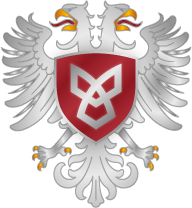
The national flag of Grozovia consists of three primary colors, blue – green & red, divided equally along the fess. The charge in the center includes a traditional Grozovian two-headed eagle holding a shield displaying the symbol of Sventovit, the slavic god of war. Blue represents the winding rivers which provided us with fertile land and allowed our civilization to blossom. Green represents the Solveka Mountains which acted as a natural barrier to our enemies and allowed our people the opportunity to thrive. Red represents the blood of Grozovians, a reminder that their sacrifice should never be in vain.

Coat of Arms
The national emblem, or coat of arms, is steeped in Grozovian heraldry and closely resembles the 12th-century arms of Duke Zdenko Stasov. The emblem features a traditional Grozovian two-headed eagle on a green field, holding the symbol of Sventovit, the slavic god of war.

- Introduction
- History
- Culture
- National Symbols
- Learn More